You can access the distribution details by navigating to My pre-printed books > Distribution
Add a Review
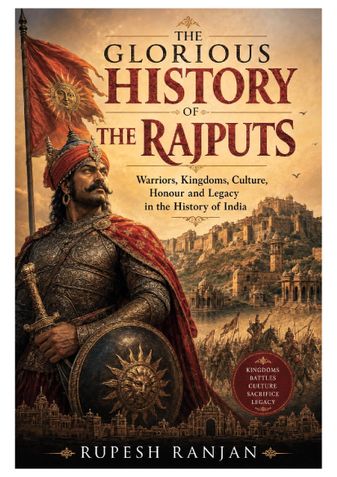
THE GLORIOUS HISTORY OF THE RAJPUTS (eBook)
Warriors, Kingdoms, Culture, Honour and Legacy in the History of India
Type:
e-book
Genre: Education & Language, History
Language: English
Price:
₹191
(Immediate Access on Full Payment)
Description
The Glorious History of the Rajputs is a comprehensive exploration of one of the most fascinating and
influential traditions in the political, military and cultural history of India. Across thirty-nine
chapters, the book traces the emergence, development, achievements, struggles, transformations and
enduring legacy of Rajput political communities from the early medieval period to modern India.
The story of the Rajputs is often remembered through magnificent forts, heroic warriors, famous
battles and celebrated rulers. While these elements form an important part of the narrative, the
history presented in this book goes considerably deeper. It examines Rajput history as a complex
phenomenon involving state formation, political authority, military organisation, landholding,
diplomacy, religion, architecture, literature, social institutions, economic life and historical memory.
The book begins with a fundamental question: Who were the Rajputs? Rather than assuming that the
term possessed an unchanging meaning throughout history, the opening chapters examine the
historical evolution of Rajput identity and the processes through which warrior lineages and political
communities emerged. Traditional genealogies, claims of ancient ancestry and later historical
interpretations are considered alongside the broader political circumstances of early medieval India.
Part I explores the geographical and political foundations of Rajput power. The landscapes of
Rajasthan, Gujarat, Malwa, Bundelkhand, central India and adjoining regions played an important
role in shaping political institutions and military strategies. Mountains, deserts, river valleys,
agricultural plains and strategic routes influenced where kingdoms emerged and how they interacted
with their neighbours.
Part II introduces some of the most important dynasties and kingdoms associated with Rajput history.
The Gurjara-Pratiharas, Chauhans, Guhilas, Sisodiyas, Rathores, Kachwahas, Paramaras, Solankis,
Chandellas, Baghelas and other regional powers receive attention. The objective is not merely to list
dynasties and rulers but to understand how these states developed, expanded, competed, negotiated
and adapted to changing political circumstances.
Among the most celebrated personalities discussed are Prithviraj Chauhan, Rana Sanga and
Maharana Pratap. Their lives have generated powerful historical traditions and heroic memories.
The book approaches these figures with admiration for their historical significance while maintaining
a distinction between evidence and later legend. This allows readers to appreciate the cultural power
of heroic narratives without confusing literary tradition with independently established historical
fact.
The book then turns from kings and battles to the broader structure of Rajput society. It examines
political organisation, kingship, nobles, chiefs, military service, succession, alliances and systems of
authority. Rajput states were not simply military camps surrounding a ruler; they were complex
political societies supported by agricultural production, taxation, landed interests, artisans, merchants, religious institutions and administrative networks.
Rajput warfare receives detailed attention because military culture was central to the political history
of many Rajput states. The book examines cavalry, infantry, elephants, fortifications, weapons, siege
warfare, battlefield strategy and alliances. Yet warfare is studied as part of a larger political system
rather than as an isolated celebration of violence.
A major theme is the Rajput warrior ethos—the ideas of courage, loyalty, honour, reputation and
sacrifice that became central to Rajput historical memory. These concepts helped shape both
contemporary political behaviour and later representations of Rajput identity. The book also
examines the ways in which such ideals were transmitted through family traditions, court literature,
bardic narratives and oral histories.
The experiences of Rajput women form another important dimension. Queens and women of royal
households could exercise political influence, sponsor temples and artistic projects, participate in
diplomatic relationships and preserve dynastic traditions. At the same time, women lived within
social structures that imposed significant expectations and restrictions. The book therefore attempts
to present their history beyond simplistic portrayals.
The difficult subjects of jauhar and saka are discussed within their historical context. Rather than
romanticising or sensationalising these practices, the book examines the circumstances of siege
warfare, the values associated with sacrifice and the way these events entered collective memory.
Such traditions are treated as subjects of historical inquiry as well as cultural memory.
The cultural achievements of Rajput and related regional courts receive substantial attention. Forts,
palaces, temples, stepwells, paintings, sculpture, manuscripts, literature and urban settlements
reveal a world of considerable artistic and architectural creativity. These monuments were not
merely symbols of royal wealth; they could express religious devotion, political legitimacy,
technological capability and regional identity.
The book also explores Rajput literature and historical memory. Court poets, genealogists, bards
and chroniclers played an important role in preserving the reputations of rulers and lineages. Heroic
poetry transformed historical events into powerful cultural narratives. Over generations, these
narratives became part of the collective memory of communities and regions.
The later chapters examine the major political encounters that transformed northern and western
India. Rajput states interacted with Ghaznavid and Ghurid forces, the Delhi Sultanate, the Mughal
Empire and later the Marathas. These relationships involved warfare, resistance and conquest, but
also diplomacy, alliances, political accommodation and service within larger imperial structures.
The relationship between Rajput states and the Mughal Empire receives particular attention. The
history was neither one of permanent conflict nor complete political submission. Different Rajput
houses followed different strategies at different moments. Some fought the Mughals, some entered
alliances, some served within the imperial administration and military establishment, while others
attempted to preserve greater autonomy. This diversity is essential to understanding the political
history of the period.
The book subsequently follows the transformation of Rajput power during the eighteenth and
nineteenth centuries. The rise of the Marathas, the weakening of Mughal authority and the expansion
of British influence created a new political environment. Rajput states entered into relationships with
the British that preserved their dynastic institutions while substantially reducing their sovereignty.
The story continues into the twentieth century, when nationalism, political reform and the end of princely rule transformed the position of Rajput ruling houses. The integration of princely states into
independent India marked the end of Rajput political rule in its traditional form, but it did not mark
the disappearance of Rajput heritage.
Today, Rajput history survives through monuments, family traditions, literature, folklore, festivals,
museums, tourism, popular culture and historical scholarship. Forts that once served as centres of
military power have become important heritage sites. Former royal residences preserve memories of
another political age. Historical personalities continue to inspire literature, cinema and public
discussion.
At the same time, the book recognises that historical memory can be selective. Legends may become
stronger than documentary evidence; political narratives can reinterpret the past; and popular culture
can transform complex historical personalities into simplified symbols. Consequently, the work
repeatedly distinguishes among historical evidence, traditional narratives, literary memory and
modern interpretation.
The title The Glorious History of the Rajputs reflects the extraordinary achievements and enduring
cultural influence of Rajput traditions, but "glorious" is not intended to mean flawless. The history of
every society contains achievements as well as conflicts, political rivalries, social inequalities and
failures. A mature understanding of history does not require either uncritical glorification or
dismissal. It requires the courage to examine the past honestly.
This book therefore seeks to present Rajput history with respect, balance and intellectual openness. It
celebrates courage without turning history into mythology, recognises resistance without ignoring
diplomacy, appreciates monuments without overlooking the societies that created them, and respects
traditional memory while giving importance to historical evidence.
Ultimately, The Glorious History of the Rajputs is not only a story of warriors and kingdoms. It is a
story of people, landscapes, institutions, cultures and memories. It explores how political
communities emerged, how states were built, how rulers confronted changing circumstances, how
societies produced remarkable artistic achievements and how the memory of a historical tradition
survived long after its political structures had disappeared.
The book invites readers to look beyond the battlefield and discover the many dimensions of Rajput
history—from the walls of great forts to the verses of poets, from royal courts to agricultural
villages, from political alliances to religious traditions, and from medieval kingdoms to the cultural
landscape of modern India.
In doing so, it seeks to make the history of the Rajputs accessible not only to students and history
enthusiasts, but to every reader interested in understanding the rich, diverse and continuously
evolving history of India.
History is not merely the memory of what happened. It is also an exploration of how people
understood their world, shaped their institutions and left their mark upon generations yet to come.
About the Author
Book Details
Number of Pages: 926
Availability:
Available for Download (e-book)
Ratings & Reviews
THE GLORIOUS HISTORY OF THE RAJPUTS
Review This Book
Write your thoughts about this book.

Currently there are no reviews available for this book.
Be the first one to write a review for the book THE GLORIOUS HISTORY OF THE RAJPUTS.
Other Books in Education & Language, History

Daniele Cataldi

Vivek Malviya Founder – Stock Biz | The ...
Ashwini Kumar Aggarwal
Prof. (Dr.) P.L.Mohapatra, Dr.P.K.Mishra