You can access the distribution details by navigating to My Print Books(POD) > Distribution
Add a Review
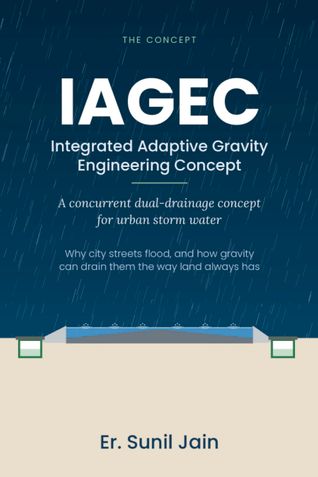
IAGEC-The Concept
Integrated Adaptive Gravity Engineering Concept:A Concurrent dual-drainage concept for urban storm water
Er. Sunil JainDescription
Every monsoon, Indian cities flood, often in the same places, year after year. The usual answer is a bigger underground pipe. But much of the rain that falls on a city never reaches those pipes in time. It runs over roads and open ground, collects in low spots, and waits there until the system can take it. That waiting is what we call waterlogging.
IAGEC begins from a simple observation of nature: water moves by gravity and always finds its own way down. The Integrated Adaptive Gravity Engineering Concept proposes a covered surface drainage network that works alongside the conventional underground system, not in place of it. From the first drop of rain, both systems carry runoff at the same time through their own independent inlets, each to its own disposal point. The surface network leads the water to zonal outfalls: natural depressions or engineered ponds, with recharge wells that return it to the ground instead of wasting it.
Written in plain language for engineers, planners, administrators and interested readers, this book explains:
why underground drains alone cannot prevent waterlogging during heavy storms
how the surface and underground systems share the work concurrently
how runoff is captured, channelised and disposed of zone by zone
how outfall ponds and recharge wells turn floodwater into groundwater
a fully calculated illustrative example of a 540-acre urban sector
The book draws on the author’s decades of field experience and on established published guidance on urban drainage. It presents IAGEC as a concept offered for open technical discussion, feasibility study and pilot validation, so that engineers everywhere can examine it, test it and build on it.
About the Author
Book Details
Publisher: self published
Number of Pages: 97
Dimensions: 6.00"x9.00"
Interior Pages: B&W
Binding:
Paperback (Perfect Binding)
Availability:
In Stock (Print on Demand)
Ratings & Reviews
IAGEC-The Concept
Review This Book
Write your thoughts about this book.

Currently there are no reviews available for this book.
Be the first one to write a review for the book IAGEC-The Concept.
Other Books in Engineering
Sitangshu Sekhar Biswas, Snehangshu Sekhar Biswas, Dr. R. ...

Narender Sharma

DHEERAJ DEWANGAN

Loganathan Moorthy