You can access the distribution details by navigating to My Print Books(POD) > Distribution
Add a Review
Type:
Print Book
Genre: Literature & Fiction, Reference
Language: English
Price:
₹779
+ shipping
Description
Contents
1. Treatises, Essays and Criticism: Critical Theory and the Criticism of Criticism 9
2. Pattern Poetry and Shape Poetry in Maithili 24
3. A Navya-Nyāya Perspective: Valid Cognition, Absence and Epistemic Validity 26
4. The Place of the Vihani Tale in Prose Literature and Its Critical Theory 27
5. The Place of the Short Story in Prose Literature and Its Critical Theory 32
6. The Place of the Novel in Prose Literature and Its Critical Theory 41
7. Literature for Infants, Children and Adolescents, and Its Critical Theory 45
8. A Theory of Translation for Maithili and the Criticism of Translated Literature 51
9. Poetry and Its Critical Theory 54
10. Dramatic Literature, Parallel Maithili Drama and Theatre, and the Critical Theory of Dramatic Literature 133
11. Maithili Haiku, Haikū, and Kshanika 146
12. Dohā, Rolā, and Kuṇḍaliyā 150
13. The Critical Theory of Maithili Prose and Poetry 157
14. Maithili Drama and Modern Theatre 205
15. Foundations of Maithili Theatre Criticism: Text, Performability and Comparative Method 221
16. Kunal's Dramaturgy: Folk Theatre, Classical Tradition and Modernity 222
17. Kuṇḍaliyā in Laldas's Mithila Ramayana and an Examination of Metre 223
18. Language, Metre and Poetic Beauty: Rasa, Dhvani and Vakrokti 231
19. The Ideological Ground: A Parallel Literary Perspective and Theatre 232
20. Towards a Woman-Centred Critical Theory for Maithili (Including Queer Feminism): With Reference to Kamini's A Woman Divided into Fragments and Shanti Lakshmi Chaudhary's Lesbian Continuum 233
Overall Evaluation 246
Section 2: The Videha Parallel-History Framework 250
Section 3: Indian Aesthetics—Rasa, Dhvani, Vakrokti and Aucitya 252
Section 4: Western Theories of Criticism 258
Section 5: Chinese Philosophical Traditions 263
Section 6: Comparative Analysis and Overall Evaluation 266
Contents · continued
Shanti Lakshmi Chaudhary's “Lesbian Continuum”: A Critical Review and Comparative Analysis with Kamini 270
Section 1: Poetic Structure and Ideological Architecture 270
Section 2: Theoretical Foundations and Western Sources 271
Section 3: A Critique of Male Sexuality 272
Section 4: A Queer Re-reading of Maithil Folk Tradition 273
Section 5: Comparative Analysis with Kamini 274
Section 6: Evaluation through Gangesha's Navya-Nyāya 276
Section 7: Place within Videha Parallel History 278
Section 8: Evaluation through Indian Aesthetics 278
Section 9: Evaluation through Western and Chinese Theory 279
Section 10: Limitations and Critical Questions 281
Section 11: Historical Importance and Future Directions 282
21. Towards a Critical Theory of Dalit Literature for Maithili — II 284
Jyotsna Phanija — An Exploration of Caste Conflict in Selected Maithili Stories 307
22. A Critical Theory of Dalit Literature for Maithili 317
23. A Parallel Grammar, Composition and Linguistics of Maithili 325
24. The Origin and Development of the Tirhuta Script 366
Comparative Study: Maithili and the Neighbouring Indo-Aryan and Austroasiatic Languages 382
25. Agricultural and Fisheries Vocabulary (Based on Fieldwork) 404
26. Verbal Testimony, Epistemology and Linguistics 409
27. Maithili Wikipedia, Unicode Tirhuta–Kaithi, and Digital Maithili 431
28. Before Writing a Literary Work… 472
29. Maithili, Surjapuri and Rajbanshi 526
30. Folk Elements in Literature: Ballads, Dance and Drama 528
31. Hindi, Maithili and Literary Vocabulary 530
32. The Place of Maithili in the Indo-European Language Family 536
33. Acting Workshop 579
34. A Parallel World of Maithili Drama and Film 587
35. The Impact of Foreign Capital Investment on Languages, Including Maithili 590
Contents · continued
36. Jayakant Mishra and the Maithili Dictionary 596
37. Administrative and Social Vocabulary Found in the Pañjī System 603
38. The Influence of English Literature on the Maithili Novel 615
39. Reflections on Words: Siddha Sarahapada, the Tibetan Script, Computers and Maithili 619
40. Workshop in Storytelling and Story Writing (With Special Reference to Children's Stories) 629
41. Why Should Readers Read My Books? 632
Now let us turn to some of my haiku, senryū, tanka and haibun. 643
Nature's Anger 643
The Flag Song of Mithila 650
Now, the vihani tale 651
Polygamy and a Hijra 652
Short Stories 654
Ulkmukh (a play) 655
Maithili Critical Theory, A Theory of Translation for Maithili, and Maithili Ghazal Theory 656
Maithili Critical Theory 656
A Theory of Translation for Maithili 656
Maithili Ghazal Theory 656
Vidyapati's Bidesiya 657
For Candidates Preparing for Competitive Examinations 657
My Translated Literature 658
42. Weight Management: A Personal Experiment and Experience 661
43. Annie Ernaux and the Fictional World of Kapileshwar Raut 664
44. The Sharadindu Chaudhary Special Issue and Parallel Literary Discourse 667
45. The Premlata Mishra “Prem” Special Issue and Parallel Literary Discourse 673
46. The International Presentation of Maithili Literature and Parallel Literary Discourse 676
47. Folk Culture, Literature, Book Criticism, and the Parallel Perspective 685
48. The Sahitya Akademi and Maithili Literary Organisations: A Discussion 700
49. Parallel Literature in Maithili and the Videha Maithili Literary Movement 703
Contents · continued
50. Maithili Literary Organisations, the Sahitya Akademi, and a Re-reading of Dhūrttasamāgama 712
51. The Sahitya Akademi Translation Award (Maithili), 2022: A Literary Debate 716
52. The Sahitya Akademi's Maithili Advisory Committee (2023–2028): A Discussion 753
53. The Mithila Student Union Special Issue: Organisation, Movement and Criticism 756
54. Language and Technology (Computers, Photography, Keyboards and Typing Techniques), Maithili on the Internet, Writing on the World Wide Web and E-Publishing 757
55. The Internet and Maithili 764
56. Self-Image, Language Technology and Inclusive Communication 767
About the Author
Book Details
Publisher: Videha eJournal
Number of Pages: 778
Dimensions: 6"x9"
Interior Pages: B&W
Binding:
Hard Cover (Case Binding)
Availability:
In Stock (Print on Demand)
Ratings & Reviews
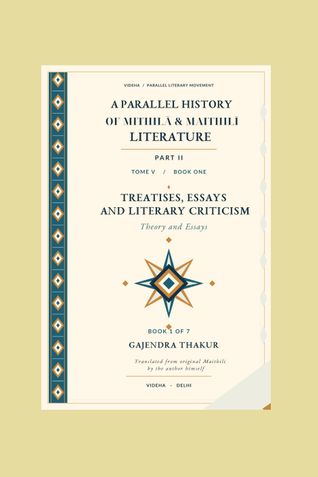
A PARALLEL HISTORY of Mithila & Maithili Literature PART II [Tome V · Book One]
Review This Book
Write your thoughts about this book.

Currently there are no reviews available for this book.
Be the first one to write a review for the book A PARALLEL HISTORY of Mithila & Maithili Literature PART II [Tome V · Book One].
Other Books in Literature & Fiction, Reference
डॉ. रक्षित बागडे

Amrita Mukherjee

Dr. Upasana

The final Network Marketing Bible Wrapping Businesses, Strategies ...