You can access the distribution details by navigating to My Print Books(POD) > Distribution
Add a Review
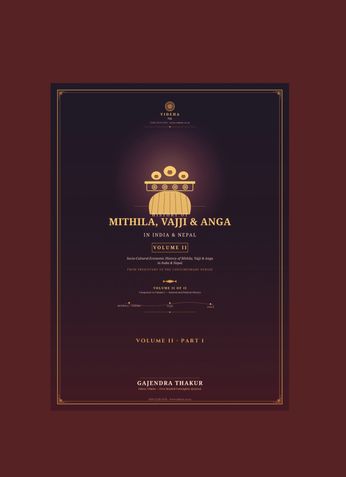
HISTORY OF MITHILA, VAJJI & ANGA IN INDIA & NEPAL — VOLUME II Part 1
Socio-Cultural-Economic History of Mithila, Vajji & Anga in India & Nepal From Prehistory to the Contemporary Period
GAJENDRA THAKURDescription
Contents
PART I — LAND, ENVIRONMENT AND THE MAKING OF HUMAN LANDSCAPES 23
Chapter 1 — The Physical Foundations of Society 24
Chapter 2 — Prehistoric Settlement and Subsistence 32
Chapter 3 — CHALCOLITHIC AND EARLY AGRARIAN COMMUNITIES 42
Chapter 4 — ARCHAEOLOGY OF FOOD AND EVERYDAY LIFE 49
Chapter 5 — ENVIRONMENT, MOBILITY AND SETTLEMENT 57
PART II — EARLY HISTORIC SOCIETY: VIDEHA, VAJJI AND ANGA 63
Chapter 6 — THE SECOND URBANISATION 64
Chapter 7 — HOUSEHOLD AND FAMILY IN EARLY HISTORIC SOCIETY 72
Chapter 8 — SOCIAL DIFFERENTIATION BEFORE FIXED CASTE NARRATIVES 80
Chapter 9 — WOMEN IN EARLY MITHILA–VAJJI–ANGA 89
Chapter 10 — AGRICULTURE AND THE RURAL ECONOMY 97
Chapter 11 — CRAFTS AND TECHNOLOGY 105
Chapter 12 — Trade, Merchants and Markets 113
Chapter 13 — Vaishali as an Economic and Social Centre 122
Chapter 14 — Anga and Champa 130
Chapter 15 — Early money and monetisation 138
Chapter 16 — Buddhist and Jain institutional economies 148
Chapter 17 — Education, debate and intellectual communities 159
Chapter 18 — Health, medicine and the body 168
PART III — RELIGION, RITUAL AND CULTURAL FORMATION 178
Chapter 19 — From Vedic ritual landscapes to regional religious cultures 179
Chapter 20 — Buddhism in the social history of Vajji and Videha 189
Chapter 21 — Jainism and the Vaishali–Videha landscape 198
Chapter 22 — Śaiva, Śākta and Vaiṣṇava transformations 207
Chapter 23 — Sacred geography 216
Chapter 24 — Festivals and calendrical culture 225
Chapter 25 — Death, ancestors and life-cycle rites 235
PART IV — EARLY MEDIEVAL AND MEDIEVAL SOCIAL TRANSFORMATION 244
Chapter 26 — Land Grants and Changing Agrarian Society 245
Chapter 27 — Village, Market and Town 254
Chapter 28 — Labour, Service and Occupational Communities 264
Chapter 29 — Social Classification and Its Historical Formation 272
Chapter 30 — Brahmanical Institutions without Retrospective Caste Projection 281
Chapter 31 — The Panji Tradition 290
Chapter 32 — Women, Marriage and Property in Medieval Mithila 299
Chapter 33 — Karnata and Oiniwar-Period Social Economy 308
Chapter 34 — Islam, Migration and New Social Worlds 317
Chapter 35 — Persianate Culture and Mithila–Anga 326
PART V — LANGUAGE, LITERATURE AND KNOWLEDGE AS SOCIAL HISTORY 333
Chapter 36 — Languages Before Modern Standardisation 334
Chapter 37 — Formation of Literary Maithili 343
Chapter 38 — The Two Vidyāpatis and Two Historical Contexts 352
Chapter 39 — Tirhuta/Mithilakshar and Scribal Culture 360
Chapter 40 — Oral Culture 368
Chapter 41 — Angika and the Eastern Linguistic-Cultural Zone 376
Chapter 42 — Bajjika and Western Mithila 385
Chapter 43 — Sanskrit Learning and Scholastic Institutions 394
PART VI — MATERIAL CULTURE AND THE ARTS 402
Chapter 44 — Architecture and Settlement 403
Chapter 45 — Dress, Textiles and Ornament 412
Chapter 46 — Food History of Mithila, Vajji and Anga 420
Chapter 47 — Mithila Painting Before and Beyond the Modern Art Market 428
Chapter 48 — Mithila Painting and the Twentieth-Century Cultural Economy 436
Chapter 49 — Music, Song and Performance 445
Chapter 50 — Theatre and Dramatic Cultures 453
Chapter 51 — Fairs, Markets and Public Culture 461
PART VII — EARLY MODERN AND COLONIAL ECONOMIC TRANSFORMATIONS 468
Chapter 52 — Mughal-Period Land, Revenue and Agrarian Society 469
Chapter 53 — Trade between Bengal, Bihar, Nepal and the Gangetic World 477
Chapter 54 — East India Company Expansion and the Remaking of Agrarian Relations 485
Chapter 55 — Permanent Settlement and Landed Society 493
Chapter 56 — Indigo and Commercial Agriculture 500
Chapter 57 — Opium and Other Commodity Networks 507
Chapter 58 — Famines, Scarcity and Food Security 515
Chapter 59 — Colonial Surveys and the Invention of Social Categories 524
Chapter 60 — Education under Colonialism 532
Chapter 61 — Print Culture 541
Chapter 62 — Railways, Roads and Changing Markets 551
Chapter 63 — Labour Migration 559
Chapter 64 — Women and Colonial Modernity 568
PART VIII — NEPAL MITHILA / MADHESH AS A SOCIAL AND ECONOMIC REGION 576
Chapter 65 — The Historical India–Nepal Borderland Economy 577
Chapter 66 — Janakpur as Religious, Commercial and Urban Centre 586
Chapter 67 — Land, Tenancy and Agrarian Society in the Nepal Tarai 594
Chapter 68 — Forest Clearance, Malaria Control and Demographic Transformation 602
Chapter 69 — Migration and Settlement 610
Chapter 70 — Language, Education and Cultural Institutions in Nepal 617
Chapter 71 — Gender, Citizenship and Household Economy in Madhesh 625
Chapter 72 — Janakpur Art, Crafts and Cultural Economy 633
Chapter 73 — Border Markets, Remittances and Informal Exchange 640
PART IX — POST-1947 / POST-1950 DEVELOPMENT 647
Chapter 74 — Independence, Land Reform and Agrarian Change in Bihar 648
Chapter 75 — Abolition of Zamindari and Its Uneven Consequences 656
Chapter 76 — Agriculture after Independence 664
Chapter 77 — Kosi, Gandak and Major River-Development Projects 672
Chapter 78 — Floods as Social and Economic History 680
Chapter 79 — Rural Credit, Indebtedness and Banking 688
Chapter 80 — Cooperatives and Rural Institutions 696
Chapter 81 — Industrialisation and Its Limits 705
Chapter 82 — Bhagalpur Silk and Anga’s Textile Economy 714
Chapter 83 — Makhana, Fish, Dairy and Specialised Regional Economies 723
Chapter 84 — Education after Independence 732
Chapter 85 — Health and Public-Health Transformation 741
Chapter 86 — Roads, Railways, Electricity and Communications 750
PART X — CASTE, CLASS, GENDER AND SOCIAL CHANGE 758
Chapter 87 — Historical Formation of Caste Relations 759
Chapter 88 — Dalit Histories 769
Chapter 89 — Adivasi and Forest-Connected Populations Where Regionally Relevant 778
Chapter 90 — Muslims of Mithila and Anga 786
Chapter 91 — Gender and the Household Economy 794
Chapter 92 — Women’s Paid and Unpaid Labour 803
Chapter 93 — Marriage, Dowry, Inheritance and Changing Family Structures 812
Chapter 94 — Education and Social Mobility 821
Chapter 95 — Reservation, Affirmative Action and New Middle Classes 830
Chapter 96 — Rural Elites, Political Economy and Changing Landed Power 839
PART XI — MIGRATION, URBANISATION AND DIASPORA 848
Chapter 97 — The Longue Durée of Migration 849
Chapter 98 — Calcutta/Kolkata and Mithila–Anga Migration 858
Chapter 99 — Delhi, Mumbai and Post-Independence Mobility 867
Chapter 100 — Punjab, Haryana and Seasonal Agricultural Labour 876
Chapter 101 — Nepal–India Circular Migration 885
Chapter 102 — Gulf Migration 893
Chapter 103 — Remittances and Household Transformation 902
Chapter 104 — Urbanisation 910
Chapter 105 — Informal Economies and Street Commerce 918
Chapter 106 — Diaspora Cultural Institutions 926
PART XII — CULTURAL MODERNITY AND MASS MEDIA 934
Chapter 107 — Maithili Print and Literary Institutions 935
Chapter 108 — Angika Print and Literary Institutions 945
Chapter 109 — Radio and Broadcasting 953
Chapter 110 — Cinema, Video and Recorded Performance 961
Chapter 111 — Newspapers and Public Debate 970
Chapter 112 — Sahitya Akademi, Academies and Institutional Canon Formation 979
Chapter 113 — Women Writers and Alternative Literary Publics 988
Chapter 114 — Videha and Digital Literary Culture 997
Chapter 115 — Digital Archives and Cultural Preservation 1007
Chapter 116 — Unicode, Tirhuta and Technological Recognition 1015
PART XIII — THE CONTEMPORARY ECONOMY 1022
Chapter 117 — Demographic Structure and Population Change 1023
Chapter 118 — Agriculture in the Twenty-First Century 1032
Chapter 119 — Land Fragmentation and Rural Livelihoods 1042
Chapter 120 — Migration-dependent Economies 1052
Chapter 121 — Remittances, Consumption and Housing 1062
Chapter 122 — Education Economy and Coaching Migration 1072
Chapter 123 — Health Economy 1083
Chapter 124 — Roads, Highways, Airports and Connectivity 1092
Chapter 125 — Digital Payments, Mobile Phones and Platform Economies 1103
Chapter 126 — Tourism and Pilgrimage Economies 1112
Chapter 127 — Mithila Painting in the Global Market 1122
Chapter 128 — GI, Heritage Branding and Intellectual Property 1132
Chapter 129 — Climate Change and Agrarian Risk 1142
Chapter 130 — Flood Adaptation and Resilience 1151
Chapter 131 — India–Nepal Border Economies after Federalisation 1159
PART XIV — CONTEMPORARY SOCIAL AND CULTURAL CHANGE 1168
Chapter 132 — Family Transformation 1169
Chapter 133 — Changing Marriage Practices 1178
Chapter 134 — Gender, Education and Employment 1187
Chapter 135 — Youth Culture 1197
Chapter 136 — Social Media and Language 1206
Chapter 137 — Religious Change and Public Ritual 1215
Chapter 138 — Caste in Contemporary Society 1224
Chapter 139 — Madhesh, Federalism and Social Citizenship 1234
Chapter 140 — Maithili, Angika and Bajjika in Contemporary Public Life 1244
Chapter 141 — Cultural Heritage versus Living Culture 1254
Chapter 142 — The Future of the Regional Cultural Economy 1262
PART XV — SYNTHESIS 1271
Chapter 143 — The longue durée of social change 1272
Chapter 144 — From Subsistence to Market Integration 1281
Chapter 145 — Household, Caste, Class and Gender across Time 1290
Chapter 146 — Riverine Ecology and Economic History 1299
Chapter 147 — Language as Social Infrastructure 1307
Chapter 148 — India and Nepal: One Interaction Zone, Multiple Political Economies 1315
Chapter 149 — Cultural Persistence, Reinvention and Modern Institutions 1324
Chapter 150 — Conclusion: Socio-Cultural-Economic Histories without Timeless Essences 1332
Selected Chronology 1341
Glossary 1360
Historical Place-Name Concordance 1345
Language-Name Concordance 1346
Consolidated Bibliography 1347
Index 1399
About the Author
Book Details
ISBN: 9789334494150
Publisher: Videha eJournal
Number of Pages: 441
Dimensions: 8"x11"
Interior Pages: Full Color
Binding:
Hard Cover (Case Binding)
Availability:
In Stock (Print on Demand)
Ratings & Reviews
HISTORY OF MITHILA, VAJJI & ANGA IN INDIA & NEPAL — VOLUME II Part 1
Review This Book
Write your thoughts about this book.

Currently there are no reviews available for this book.
Be the first one to write a review for the book HISTORY OF MITHILA, VAJJI & ANGA IN INDIA & NEPAL — VOLUME II Part 1.
Other Books in History
GAUTAM SHARMA

Seyed E.zamani

GN RAO
D BHATTACHARYA