You can access the distribution details by navigating to My Print Books(POD) > Distribution
Add a Review
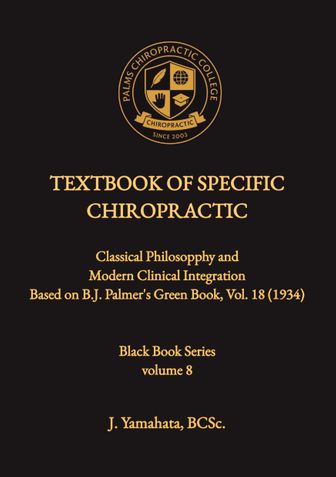
TEXTBOOK OF SPECIFIC CHIROPRACTIC
Classical Philosophy and Modern Clinical Integration Based on B.J. Palmer’s Green Book, Volume 18 (1934)
J. Yamahata, BCSc.Description
There is a difference between knowing chiropractic and thinking chiropractic.
There is a difference between calling something “specific” and making specificity the governing law of what you do with your hands.
This book stands squarely in that difference.
I did not come to Volume 18 of B.J. Palmer as a historian looking backward. I came to it as a chiropractor who had already spent years inside technique systems, listing systems, measurement systems, and neurological explanations that all claimed precision—but too often delivered approximation dressed as certainty.
What I found in Volume 18 was not sentiment. It was not philosophy as decoration. It was philosophy functioning as mechanism.
Palmer did not separate what he believed from what he built. If he declared specificity, he engineered specificity. If he insisted on locating the exact cause, he built instruments to locate it. If he demanded that correction match cause, he constructed a method that refused generality as a substitute for truth.
That is the spine of this book.
THE CENTRAL PREMISE
Specificity is not a refinement of chiropractic technique.
It is chiropractic.
Everything else is approximation.
WHAT THIS BOOK DOES
This volume re-examines the classical architecture of chiropractic through the lens of clinical necessity rather than historical admiration. It asks a simple but uncomfortable question:
If one subluxation is the cause, why would ten adjustments of uncertainty ever be superior to one correction of precision?
From that question, everything else follows.
The logic of specificity is traced back to its original construction in Palmer’s work
The relationship between structural finding and neurological meaning is clarified
The function of instrumentation is examined as an extension of principle, not a technological curiosity
The idea of “one cause, one correction” is restored to its operational meaning rather than its slogan form
Modern clinical reasoning is integrated without dissolving the classical framework that gave it direction
Where early 20th-century physiological assumptions no longer hold, they are not protected by tradition. They are identified plainly. But the structure beneath them—the insistence on precision, accountability, and causality—is left intact, because structure is not the same thing as explanation.
A NOTE ON VOICE
This book is written deliberately in a classical register.
Not because the past must be imitated, but because conviction in chiropractic was never meant to sound uncertain. The declarative tone is not aesthetic. It is structural. It reflects a way of thinking where premise leads to method without apology.
Where modern interpretation becomes necessary, it steps forward clearly and breaks that voice without blending into it.
Two languages are used here: one of conviction, one of correction. They are not allowed to blur into each other.
FOR THE PRACTITIONER
This is not a book of technique variations.
It is a book about why technique must exist at all.
It is written for those who have already discovered that general work produces general results, and who are no longer satisfied with treating specificity as a marketing term instead of a clinical discipline.
It connects the system presented in Volume 7 of this series back to its philosophical origin in Volume 18, not as history—but as working logic.
FINAL WORD
Chiropractic was never meant to drift into approximation.
It was built on the insistence that cause is specific, and therefore correction must be specific.
Anything less is not refinement.
It is departure.
About the Authors
Book Details
Publisher: PCC PRESS
Number of Pages: 260
Dimensions: 5.83"x8.27"
Interior Pages: B&W
Binding:
Paperback (Perfect Binding)
Availability:
In Stock (Print on Demand)
Ratings & Reviews
TEXTBOOK OF SPECIFIC CHIROPRACTIC
Review This Book
Write your thoughts about this book.

Currently there are no reviews available for this book.
Be the first one to write a review for the book TEXTBOOK OF SPECIFIC CHIROPRACTIC.
Other Books in Medicine & Science

Dr. Naresh Sharma

Prem Saran Tirumalai

Dharmender Singh

Dr. Arohi Chauhan, Dr Sandeepkumar Chauhan