You can access the distribution details by navigating to My Print Books(POD) > Distribution
Add a Review
Type:
Print Book
Genre: Science & Technology, Theology
Language: English, Hindi
Price:
₹190
+ shipping
This book ships within India only.
Description
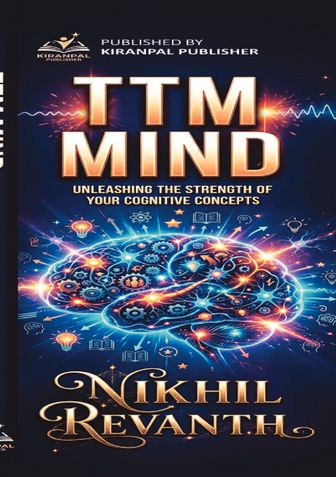
TTM MIND (Time Ton Mind) is an interdisciplinary book that introduces a new conceptual framework for understanding the relationship between time, focus, mental effort, and human productivity. Rather than measuring success only by the number of hours a person works, TTM proposes that the true value of any activity depends on how much of the mind is genuinely present during that time. The central idea is simple yet powerful: time without focused attention creates little value, while even a short period of deep concentration can produce meaningful mental wealth.
TTM presents a structured system for measuring focused mental effort through the formula Time × Mind, where Mind is always expressed as a percentage and the result is measured in the unit ₮M. The official TTM Symbol (₮M) is pronounced "Tai". Here, ₮ represents Time and M represents Mind, together symbolizing focused mental value. ₮M (Tai) is not a real currency, but a symbolic unit designed to measure mental effort, awareness, and focused productivity.
The book combines concepts from Psychology, Mathematics, Productivity Science, Behavioral Economics, and Philosophy into one integrated framework. Instead of viewing time merely as hours and minutes, it encourages readers to see time as a form of mental investment whose value depends entirely on focus, awareness, and purposeful action.
The first chapter, Introduction to TTM, explains the foundation of the entire framework. It introduces the meaning of Time Ton Mind, the core TTM Formula, the Hidden Balance Rule (HBR), the official symbol ₮M (Tai), TTM Power, TTM Value, and the relationship between focused attention and productivity. Through numerous real-life examples, exercises, and practical calculations, readers learn how to estimate mental effort, calculate TTM values, and understand why focused work creates greater value than simply spending more time on a task.
The second chapter, TTM and All the Currencies of the World, introduces one of the book's most distinctive concepts. It presents TTM as a symbolic mental currency, demonstrating that true wealth originates from focused thinking rather than printed money. Within the educational model presented in the book, 1 ₮M is symbolically equivalent to 50 units of any currency, including the Rupee, Dollar, Euro, Pound, Yen, Yuan, Won, and Dirham. This symbolic comparison is designed solely to explain the concept of mental value and is not an actual exchange rate or financial system. The chapter also introduces conversion formulas between TTM and symbolic currency values, supported by practical examples and exercises.
The third chapter, TTM Measurement System, develops a complete framework for evaluating human focus. It introduces TTM Percentage, TTM Range, and TTM Zones, allowing readers to estimate how effectively they are using their time. The system classifies performance into Low Zone, Medium Zone, Perfect Zone, and High Performance Zone, providing a practical method for self-evaluation. Detailed formulas, worked examples, analytical exercises, and real-life scenarios help readers understand their own productivity and identify areas for improvement.
The fourth chapter, Incomplete Mind Theory, presents a philosophical and psychological perspective on the human mind. It challenges the widespread belief that people should constantly strive to operate at 100% mental capacity. According to this theory, the mind is naturally incomplete, and this incompleteness is not a weakness but a protective mechanism. The chapter introduces concepts such as the Incomplete Mind Axiom (IMA), The 100–100 Illusion, Mental Resistance, Mental Elasticity Theory (MET), Half-Mind Maximum Output Law, Mind Noise Principle (MNP), and Acceptance Power Theory (APT). Together, these principles explain why excessive pressure often reduces performance, why mental balance is more sustainable than perfection, and why acceptance can become a source of long-term strength.
The fifth chapter, Mirror Mind Theory (MMT), explores how repeated thoughts, experiences, emotions, and perceptions gradually shape human identity. It presents the mind as a mirror that reflects reality according to attention, repetition, and emotional intensity. The chapter introduces advanced concepts including Mental Angle Theory (MAT), Dual Mirror Effect (DME), Broken Mirror Rule (BMR), Mirror Saturation Theory (MST), Silent Mirror Principle (SMP), Selective Reflection Rule (SRR), Future Reflection Theory (FRT), Mirror Echo Law (MEL), Identity Reflection Constant (IRC), and the Supreme Mirror Principle (SMP). These ideas explain how beliefs are formed, how identity develops over time, and how consistent mental reflection influences behavior, decisions, and personality.
Throughout the book, readers will find mathematical formulas, conceptual explanations, practical illustrations, solved examples, exercises, analytical discussions, and philosophical interpretations designed to transform abstract ideas into practical tools for daily life. The book encourages readers to observe not only how long they work, but how effectively their mind participates during that time.
TTM MIND is intended for students, educators, researchers, professionals, entrepreneurs, and anyone interested in productivity, self-development, focus, learning, psychology, time management, or human performance. Rather than presenting motivation alone, the book introduces a structured conceptual framework that readers can explore, analyze, and apply in their own lives.
Ultimately, TTM MIND invites readers to reconsider one of life's most important questions: What creates real value—time itself, or the quality of the mind invested within that time? Through the TTM framework, the book offers a new perspective that places focused awareness, mental discipline, and purposeful use of time at the center of personal growth and meaningful achievement.
About the Author
Book Details
ISBN: 9789355923141
Publisher: Karanpal publisher
Number of Pages: 138
Dimensions: A5
Interior Pages: B&W
Binding:
Paperback (Perfect Binding)
Availability:
In Stock (Print on Demand)
Ratings & Reviews
TTM MIND
Review This Book
Write your thoughts about this book.

Currently there are no reviews available for this book.
Be the first one to write a review for the book TTM MIND.
Other Books in Science & Technology, Theology

Dr. Lova, Smaily Madhuri Pammi
A Yashudas, Pradeep Singh, Prof. Dr. B.K Sarkar, ...
A Yashudas, Pradeep Singh, Prof. Dr. B.K Sarkar, ...

DR. JOSE KUDAKASSERIL