You can access the distribution details by navigating to My Print Books(POD) > Distribution
Add a Review
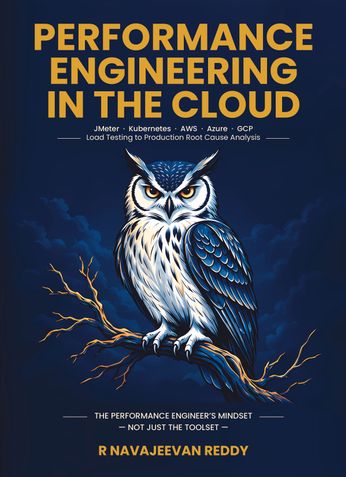
PERFORMANCE ENGINEERING IN THE CLOUD
JMeter, Kubernetes, AWS, Azure, and GCP Load Testing to Production Root Cause Analysis
R Navajeevan Reddy
This book ships within India only.
Description
Performance Engineering in the Cloud
From Performance Testing to Engineering Excellence
Most performance testing books end where the job begins. This one starts there.
A load test has failed. P99 latency is rising, dashboards are turning red, and the team needs answers. Is the bottleneck in application code, JVM garbage collection, database queries, connection pools, infrastructure, Kubernetes, or a downstream service?
Finding the cause takes more than running a load test. It takes the ability to connect test results with application behaviour, metrics, logs, traces, and system architecture.
Performance Engineering in the Cloud is a practical guide to modern performance testing and engineering. It moves beyond scripting and tool operation to show how engineers investigate performance problems, validate root causes, and improve systems across the technology stack.
INSIDE THE BOOK
• Performance engineering fundamentals: workload modelling, SLAs, performance requirements, capacity planning, scalability, and test strategy.
• Load testing tools: practical guidance for Apache JMeter, LoadRunner, Gatling, NeoLoad, and k6.
• Script engineering: recording, scripting, correlation, parameterisation, test data, execution, and distributed load generation.
• Application and API performance: REST services, microservices, distributed systems, and bottleneck analysis.
• JVM and database performance: garbage collection, heap and thread dumps, SQL tuning, and connection-pool behaviour.
• Observability and APM: metrics, logs, and distributed traces to investigate issues and understand application behaviour.
• Cloud-native performance: AWS, Azure, Google Cloud, containers, Kubernetes, scaling, and resource management.
• CI/CD and shift-left testing: automated performance checks and regression detection in delivery pipelines.
• Chaos engineering: examining how failures and infrastructure disruptions affect performance under load.
• AI and LLM-assisted performance engineering: practical opportunities, agent-based workflows, limitations, and engineering validation.
• Practical investigations and exercises: follow symptoms, gather evidence, test hypotheses, identify root causes, apply fixes, and retest.
A DIFFERENT WAY TO APPROACH PERFORMANCE
The book follows a consistent engineering approach:
Symptom → Observation → Data → Hypothesis → Validation → Root Cause → Fix → Retest.
Rather than treating performance testing as a report of response times and throughput, it develops the investigative mindset needed to explain why a system behaves as it does. Observability is part of that investigation throughout the book, not an afterthought. A continuing retail-platform example connects concepts across chapters.
WHO IS THIS BOOK FOR?
• Performance testers who want to grow into performance engineering.
• JMeter, LoadRunner, Gatling, NeoLoad, and k6 practitioners.
• Senior performance engineers, technical leads, and solution architects.
• Developers, SREs, DevOps engineers, and cloud professionals.
• Engineering managers responsible for application reliability and performance.
• Professionals preparing for performance testing, performance engineering, and architecture interviews.
Whether you are building your foundations or leading complex performance investigations, this book offers practical concepts and a structured way to think through real-world challenges in modern applications and cloud environments.
No path required—just a passion to learn. Let this book be your head start into engineering.
R Navajeevan Reddy
About the Author
Book Details
ISBN: 9789334587258
Publisher: Self Published
Number of Pages: 594
Dimensions: 8"x11"
Interior Pages: Full Color
Binding:
Paperback (Perfect Binding)
Availability:
In Stock (Print on Demand)
Ratings & Reviews
PERFORMANCE ENGINEERING IN THE CLOUD
Review This Book
Write your thoughts about this book.

Currently there are no reviews available for this book.
Be the first one to write a review for the book PERFORMANCE ENGINEERING IN THE CLOUD.
Other Books in Engineering
Syeda

SANTOSH KUMAR

Ashwini Dole
