You can access the distribution details by navigating to My Print Books(POD) > Distribution
Add a Review

கண்ணனின் திருக்கதை
டாக்டர் ரா. சீனிவாசன்
On Being A Hindu. Simply.
Sengamalam
Queen ant
Maqsood Qureshi
प्राणीसृष्टी
Prin. Dr. Kishore Pawar
 Free Shipping
Description
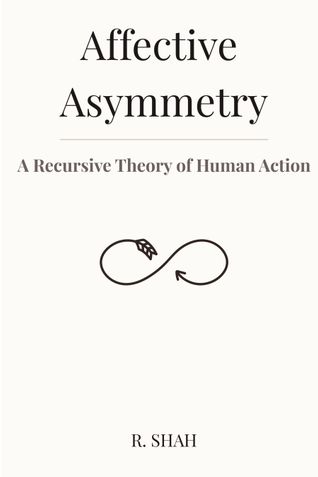
Why do people fail to act on what they already understand?
In Affective Asymmetry, R. Shah develops an original framework for human behavior, integrating insights from neuroscience and philosophy.
At its core is a simple but powerful claim: action does not follow what we know, it follows what feels relatively better in the moment. Shah calls this affective asymmetry, a shifting gradient of significance that determines which option is taken.
This explains a familiar experience: we often know what we should do, yet act otherwise. The gap is not a failure of knowledge, but a feature of how action is structured.
The book develops a recursive model in which behavior reinforces the conditions that produce it, habits encode expected outcomes, and self control works by reshaping valuation rather than overriding it.
It extends this framework to identity, narrative, and social context, showing how patterns of action accumulate into stable selves and are shaped by shared meanings and norms.
It also challenges common assumptions about agency and responsibility. What we call “choice” does not arise from an independent self, but from the structure of valuation itself.
A clear and thought provoking account for readers interested in human behavior, neuroscience, and philosophy of mind.
About the Author
Book Details
ISBN: 9798903302567
Number of Pages: 94
Dimensions: 6"x9"
Interior Pages: B&W
Binding:
Paperback (Perfect Binding)
Availability:
In Stock (Print on Demand)
Ratings & Reviews
Affective Asymmetry: A Recursive Theory of Human Action
Review This Book
Write your thoughts about this book.
Currently there are no reviews available for this book.
Be the first one to write a review for the book Affective Asymmetry: A Recursive Theory of Human Action.
Other Books in Medicine & Science, Philosophy

டாக்டர் ரா. சீனிவாசன்

Sengamalam
Maqsood Qureshi

Prin. Dr. Kishore Pawar