You can access the distribution details by navigating to My Print Books(POD) > Distribution
Add a Review
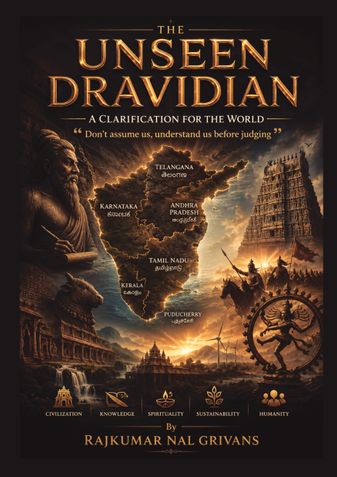
THE UNSEEN DRAVIDIAN
A Clarification for the World “Don’t assume us, understand us before judging”
RAJKUMAR NAL GRIVANSType:
Print Book
Genre: Politics & Society, History
Language: English
Price:
₹2,000
+ shipping
Description
THE UNSEEN DRAVIDIAN
A Clarification for the World
Book Summary
The Unseen Dravidian is a comprehensive exploration of one of the world's oldest continuous civilizations, written from the inside out—by a Dravidian for the world. Spanning over 5,000 years across South India, this work challenges deeply held assumptions and invites readers to step outside the narrow lens through which Dravidian civilization has been viewed.
About the Book
This is not an academic treatise, a defense, or an apology. It is an invitation—a gift to anyone who wishes to understand a civilization that has sustained itself for over five millennia. The Dravidian civilization, encompassing modern-day Tamil Nadu, Kerala, Karnataka, Andhra Pradesh, and Telangana, represents an unbroken tradition of philosophical depth, scientific achievement, and cultural resilience. Yet it remains one of the most misunderstood and misrepresented civilizations on Earth.
The West, and much of the world, has viewed Dravidians through a single pixel on a billion-screen canvas, applying its own templates and assumptions to a people who have always thought differently, lived differently, and understood existence differently. This book seeks to correct that.
What This Book Contains
A Clarification for the Western Mind
The book opens by addressing two topics through which the West most frequently misunderstands Dravidians:
The "Silent" Dravidian in the Corporate World: Why reserve is not passivity, why clarity matters more than visibility, and why Dravidians see work as a tool for life rather than life as a tool for work. With only 2–2.4 million Dravidians working in multinational corporations out of 220–250 million, the corporate lens is a distortion.
Women's Equality and Empowerment: The West's narrative on women's rights is seen through a template that does not fit. Dravidian women were never considered inferior—they were poets, warriors, queens, priestesses, and leaders. The 700 years of invasion (Islamic and British) temporarily disrupted this, but the 70+ years since independence have been a reclamation, not a learning.
Family, Marriage, and Love
From the scientific kinship systems of ancient Tamilakam to Thiruvalluvar's revolutionary philosophy of love, from Periyar's Self-Respect Movement to the profound wisdom of pregnancy rituals—this section offers a comprehensive exploration of Dravidian family life.
The Science of Kinship: The Dravidian system of cross vs. parallel cousins systematically prevented inbreeding, demonstrating biological wisdom encoded in social structures thousands of years before modern genetics.
Thiruvalluvar's Love: The Tirukkural presents love as radical equality, beauty as ethical and spiritual, and marriage as "the bond that binds the soul to the body."
The Self-Respect Revolution: Periyar transformed marriage from a sacrament into a contract based on mutual consent and equality, democratizing what had been a deeply hierarchical institution.
Valaikappu: The pregnancy ceremony is not superstition—it provides community support, stress reduction, sensory stimulation for the baby, and practical health benefits through turmeric and neem applications.
Gods, Temples, and Worship
The scientific underpinnings of Dravidian worship are explored in detail. The Garbhagriha harnesses earth's magnetic fields, the Pali Peedam serves as energetic hygiene, and the entire temple is a machine for human transformation—not blind faith but applied physics.
Nature Worship: The original Dravidian worship was rooted in gratitude—to the sun, moon, snakes, and ancestors—as the forces that sustained life.
The Siddhars: Human beings who unlocked the highest potential of existence through yoga, alchemy, medicine, and spiritual discipline. They were not mythical gods but ancestors who achieved remarkable things and contributed to society.
Temple Architecture: The Vimana and Gopuram as energy amplifiers, the chakra alignment of the temple, the geometric precision, the acoustic engineering—all demonstrate a civilization that understood energy science long before the word "quantum" existed.
The Four Pillars of Life
Aram (Virtue) — The foundation of civilization
Porul (Prosperity) — Prosperity with purpose
Inbam (Joy) — The celebration of love and beauty
Veedu (Liberation) — Beyond love lies liberation
This ethical framework, codified in the immortal Tirukkural, guided a civilization for millennia. The book demonstrates how each pillar is inseparable from the others—a complete blueprint for a meaningful human life.
Learning, Festivals, and Cuisine
The Dravidian Way of Learning: Rooted in "I don't know" and practical exploration, the ancient system of education was woven into daily life—learning from nature, elders, work, and community. Schools, by contrast, teach tools and techniques but ignore life lessons.
Festivals and Life-Cycle Rituals: Over 30 major festivals and lifecycle rituals are documented, each with scientific and psychological significance. From pregnancy rituals to puberty ceremonies, from Pongal to Onam, from Theyyam to Karthigai Deepam—the book demonstrates how these traditions preserve ecological knowledge, community bonding, and psychological wellbeing.
The Anatomy of the Dravidian Meal: A biochemically designed system for optimal digestion, glycemic control, and complete nutrition. The sequential logic—ghee and podi first, kara kuzhambu second, sambar third, rasam fourth, mor fifth, payasam sixth—is a masterclass in culinary engineering.
Traditional Cookware: The science of Kal Chatti (soapstone) and Mann Chatti (earthenware)—their thermal properties, alkaline neutralization of acids, and mineral infusion—proves that Dravidian cuisine was never just about taste but about health.
Martial Arts, Metallurgy, and Gemology
Martial Arts: Silambam (12,000+ years old), Kalaripayattu (2,300 years in origins), and Kuttu Varisai (2,300 years old) represent a science of human movement, self-defense, healing, and spiritual development. The 108 marma points of Kalaripayattu influenced Shaolin Kung Fu, Karate, Muay Thai, and other global martial arts. Bodhidharma, a Tamil prince from Kanchipuram, traveled to China and taught physical training to Shaolin monks—becoming the foundation of what would become Kung Fu.
Metallurgy: Wootz steel—the world's first super-material—was exported to Rome, with carbon content of 1.0% to 1.8% and a microstructure that gave swords razor sharpness alongside high flexibility. The word "wootz" is an Anglicized corruption of the Dravidian words ukku and uruku (to melt). Tamil Nadu's iron-smelting tradition dates back to 3,345 BCE—making it among the earliest centers of iron technology in the world.
Gemology: Golconda diamonds—the Koh-i-Noor, the Hope Diamond, the Orlov Diamond—dominated global trade. The Sanskrit word for pearl (mukta) is borrowed from the Tamil muttu, its name in the land where it was dived for.
Governance, Infrastructure, and Deindustrialization
The Uthiramerur Electoral System: A constitution-like framework from 1,100 years ago—the Kudavolai system of secret ballots, eligibility criteria, disqualifications, and transparent procedures. This was a "most remarkable piece of legislation" that preceded modern democracy by centuries.
The Kallanai Dam: Engineering for eternity, still standing after 1,900 years. Built by the Early Chola king Karikala, it remains the oldest operational dam in India and the fourth oldest in the world.
Systematic Deindustrialization: The colonial destruction of a 4,000-year technological legacy is documented in detail—the Disarmament Act of 1858, the Indian Forest Acts of 1865 and 1878, the Calico Acts of 1700 and 1721, the Indian Registration Act of 1839, the Ryotwari System of 1820. The destruction was not accidental but intentional—a calculated dismantling of an advanced regional technological ecosystem.
Art, Language, and Astronomy
Living Stone Tradition: Mortarless granite temples, interlocking dry-masonry, lost-wax bronze casting, acoustic pillars that resonate at specific musical frequencies—techniques that continue to challenge modern engineering.
Dravidian Music: The Pann system, microtonal mathematics, the mapping of five primary landscapes to specific melodies, and instruments like the Yāl (stringed harp) with over 1,000 strings—an independent musical universe.
Dravidian Language Family: An independent linguistic phylum with no structural kinship to outside families. Agglutination, inclusive
About the Author
Book Details
Number of Pages: 379
Dimensions: A5
Interior Pages: B&W
Binding:
Paperback (Perfect Binding)
Availability:
In Stock (Print on Demand)
Ratings & Reviews
THE UNSEEN DRAVIDIAN
Review This Book
Write your thoughts about this book.

Currently there are no reviews available for this book.
Be the first one to write a review for the book THE UNSEEN DRAVIDIAN.
Other Books in Politics & Society, History
Pruthvi Raj Gorkanti
Rajan Choksi
Vikramaditya Chaudhury

Meredith Bond