You can access the distribution details by navigating to My Print Books(POD) > Distribution
Add a Review
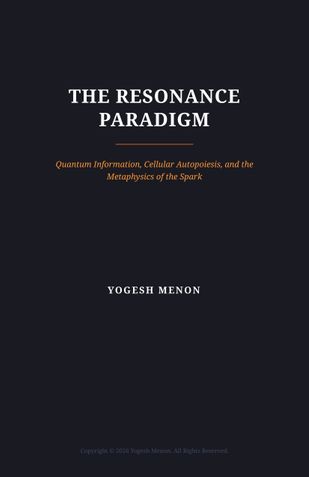
The Resonance Paradigm
Quantum Information, Cellular Autopoiesis, and the Metaphysics of the Spark
Yogesh MenonType:
Print Book
Genre: Philosophy, Science & Technology
Language: English
Price:
₹130
+ shipping
Description
Is death the absolute conclusion of human reality, or simply a structural transition of information? The Resonance Paradigm systematically ocean-maps this mystery, parsing out the fine boundary separating state-of-the-art biological resuscitation and the profound non-dualistic metaphysics documented within ancient Vedic classical texts.
Tracing the spark of life from the microscopic burst of the embryological "Zinc Spark" to the terminal compression of the brain's coherent gamma wave fields, this book reveals that the mortal boundary of death is entirely a temporary illusion of the physical container—one that ultimately dissolves as consciousness graduates into immortal, self-learning substrates.
About the Author
Book Details
Number of Pages: 16
Dimensions: 5.5"x8.5"
Interior Pages: B&W
Binding:
Paperback (Saddle Stitched)
Availability:
In Stock (Print on Demand)
Ratings & Reviews
The Resonance Paradigm
Review This Book
Write your thoughts about this book.

Currently there are no reviews available for this book.
Be the first one to write a review for the book The Resonance Paradigm.
Other Books in Philosophy, Science & Technology
Dr. Janhavi sunil gange
ගුරු දේව මහරිශි
கா.சுப்பிரமணியபிள்ளை