You can access the distribution details by navigating to My Print Books(POD) > Distribution
Add a Review
Type:
Print Book
Genre: Education & Language, Exam Preparation
Language: English, Sanskrit
Price:
₹240
+ shipping
Description
Any word in a sentence that has a direct bearing on the verb is termed as कारकः kāraka. Literally “karaka” means the one that impels action. This is directly associated with the various cases विभक्तिः that govern the sense of nouns in a sentence. A noun in a sentence can behave as the Subject, Object, Instrument, etc. This behavior of the Noun is termed as कारकः in Sanskrit.
Since this behavior is closely associated with the case of the Noun, we say that कारकः governs the case of a Noun. Thus there is the concept of कारकः विभक्तिः = कारकविभक्तिः ।
Example
Rama goes to temple from home by car on Sunday for worship.
रामः m1/1 रविवासरे m7/1 गृहात् n5/1 प्रार्थनायै f4/1 वाहनेन n3/1 मन्दिरं n2/1 गच्छति verb iii/1 ।
m = masculine, n= neuter. 1/1 = 1st case singular.
Notice that the 6th case is not a Karaka Vibhakti, since it does not connect to the Verb, rather it connects to a Noun in the sentence.
Kāraka = Noun that connects to a Verb.
---
Includes exhaustive notes on
-Genitive
-Upapada
-Vibhakti
-Sati Saptami (Locative Absolute)
-Anabhihite (Undenoted)
with Ashtadhyayi Sutras.
About the Authors
Book Details
ISBN: 9789348012227
Publisher: Devotees of Sri Sri Ravi Shankar Ashram
Number of Pages: 100
Dimensions: 6"x9"
Interior Pages: B&W
Binding:
Paperback (Perfect Binding)
Availability:
In Stock (Print on Demand)
Ratings & Reviews
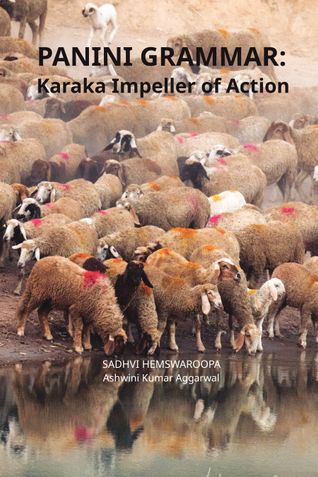
Panini Grammar: Karaka Impeller of Action
Review This Book
Write your thoughts about this book.

Currently there are no reviews available for this book.
Be the first one to write a review for the book Panini Grammar: Karaka Impeller of Action.
Other Books in Education & Language, Exam Preparation

Anantha Krishnasastry Akella

Ranjot Singh Chahal

Prof.Dr.Prarthita Biswas;MAM Sameem;Dr.Subhadeep Mazumder