You can access the distribution details by navigating to My pre-printed books > Distribution
Add a Review
Type:
e-book
Genre: Literature & Fiction
Language: English
Price:
₹199
(Immediate Access on Full Payment)
Description
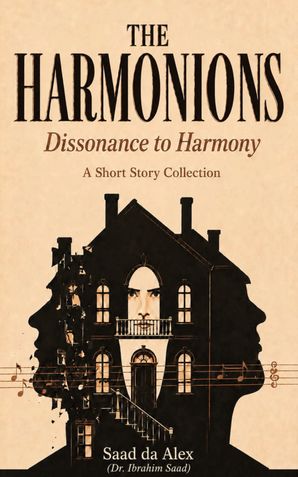
In every act of knowing there is a threshold where the knower and the known change places. These seven stories are set on that threshold.
We are born believing in a vantage point outside the world — a place from which the self can watch, weigh, and remain untouched. The Harmonions is written against that belief. There is no such place. To look closely at anything is to enter into a relationship with it, and every relationship runs both ways. The pattern you trace begins to trace you. The memory you examine begins to edit its examiner. The mind you study turns out to be the one doing the studying. The eye is inside the picture. That is not a flaw in perception; it is the condition of being a self at all.
These seven stories — the last of them a four-movement novelette — are philosophical, often uncanny meditations on what follows from that condition, each one on the surface a psychological mystery: a melody that refuses to repeat itself (The Raven Doesn’t Repeat Itself); a mathematician’s final equation, delivered in letters that arrive on schedule from no one (Dr. Warda’s Last Equation); a café whose window returns one reflection too few (The Ascent to the Edge of Perception); a sculptor haunted by a dream whose meaning is interpreted differently by those around him (As I Was Told); a colleague who exists only on Sundays (Sunday... When Thomas Comes); a manuscript and a ritual that refuse to reach their final page (The Page That Doesn’t Turn); and a pattern in the financial markets that starts to look like free will (The Harmonions). If the watcher is always also the watched, then knowledge is never a possession but a mirror — and every certainty we hold about the world is, at the same time, a confession about ourselves. Identity becomes not a fixed point but a story still being told, whose earlier drafts have been lost. Choice becomes a question: does it survive being predicted? Death, memory, creation, and inheritance appear as different names for the same passage: the moment something moves from the one who held it into the one who comes next.
The title is the book’s answer to its own unease. A Harmonion is neither a musician nor a listener; it is what a person becomes at the point where the two can no longer be told apart — the one for whom dissonance has ceased to be a threat and become a language, a self that has learned to hear the order hidden within the noise. In the closing novelette, it is also a unit of measure: the smallest interval within which a sound and the world can agree.
In music, dissonance is not disorder, but tension that has not yet found its resolution — order arriving before the ear is ready for it. So too here. The collection does not dissolve the strange by explaining it. It moves the reader, story by story, from resistance to attention, from the desire to control what is seen to the more difficult discipline of listening to it.
Some tensions resolve. Others are deliberately left open, because a sustained note can be truer than a cadence forced shut — and the silence after the final sound is sometimes where the meaning has been waiting all along.
Written in English by Egyptian author Saad da Alex (Dr. Ibrahim Saad) and rooted in the contemplative tradition of Arabic philosophical fiction, The Harmonions speaks to readers who suspect that the deepest questions are not those we ask, but those that have been quietly asking us.
About the Author
Book Details
ISBN: 9798905891021
Publisher: Dr. Eng. Ibrahim Saad.
Number of Pages: 280
Availability:
Available for Download (e-book)
Ratings & Reviews
The Harmonions
Review This Book
Write your thoughts about this book.

Currently there are no reviews available for this book.
Be the first one to write a review for the book The Harmonions.
Other Books in Literature & Fiction
Aman Raj

P Hirson

Ruben Zamora Equert

Dr. Rabin Kumar Panda