You can access the distribution details by navigating to My Print Books(POD) > Distribution
Add a Review
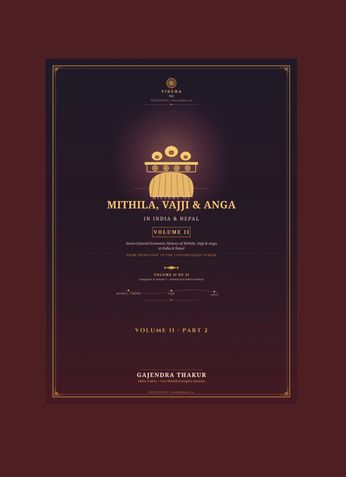
HISTORY OF MITHILA, VAJJI & ANGA IN INDIA & NEPAL — VOLUME II · PART II
Socio-Cultural-Economic History of Mithila, Vajji & Anga in India & Nepal From Prehistory to the Contemporary Period
GAJENDRA THAKURDescription
Contents
PART VI — MATERIAL CULTURE AND THE ARTS (continued)
Chapter 51 — Fairs, Markets and Public Culture
PART VII — EARLY MODERN AND COLONIAL ECONOMIC TRANSFORMATIONS
Chapter 52 — Mughal-Period Land, Revenue and Agrarian Society
Chapter 53 — Trade between Bengal, Bihar, Nepal and the Gangetic World
Chapter 54 — East India Company Expansion and the Remaking of Agrarian Relations
Chapter 55 — Permanent Settlement and Landed Society
Chapter 56 — Indigo and Commercial Agriculture
Chapter 57 — Opium and Other Commodity Networks
Chapter 58 — Famines, Scarcity and Food Security
Chapter 59 — Colonial Surveys and the Invention of Social Categories
Chapter 60 — Education under Colonialism
Chapter 61 — Print Culture
Chapter 62 — Railways, Roads and Changing Markets
Chapter 63 — Labour Migration
Chapter 64 — Women and Colonial Modernity
PART VIII — NEPAL MITHILA / MADHESH AS A SOCIAL AND ECONOMIC REGION
Chapter 65 — The Historical India–Nepal Borderland Economy
Chapter 66 — Janakpur as Religious, Commercial and Urban Centre
Chapter 67 — Land, Tenancy and Agrarian Society in the Nepal Tarai
Chapter 68 — Forest Clearance, Malaria Control and Demographic Transformation
Chapter 69 — Migration and Settlement
Chapter 70 — Language, Education and Cultural Institutions in Nepal
Chapter 71 — Gender, Citizenship and Household Economy in Madhesh
Chapter 72 — Janakpur Art, Crafts and Cultural Economy
Chapter 73 — Border Markets, Remittances and Informal Exchange
PART IX — POST-1947 / POST-1950 DEVELOPMENT
Chapter 74 — Independence, Land Reform and Agrarian Change in Bihar
Chapter 75 — Abolition of Zamindari and Its Uneven Consequences
Chapter 76 — Agriculture after Independence
Chapter 77 — Kosi, Gandak and Major River-Development Projects
Chapter 78 — Floods as Social and Economic History
Chapter 79 — Rural Credit, Indebtedness and Banking
Chapter 80 — Cooperatives and Rural Institutions
Chapter 81 — Industrialisation and Its Limits
Chapter 82 — Bhagalpur Silk and Anga’s Textile Economy
Chapter 83 — Makhana, Fish, Dairy and Specialised Regional Economies
Chapter 84 — Education after Independence
Chapter 85 — Health and Public-Health Transformation
Chapter 86 — Roads, Railways, Electricity and Communications
PART X — CASTE, CLASS, GENDER AND SOCIAL CHANGE
Chapter 87 — Historical Formation of Caste Relations
Chapter 88 — Dalit Histories
Chapter 89 — Adivasi and Forest-Connected Populations Where Regionally Relevant
Chapter 90 — Muslims of Mithila and Anga
Chapter 91 — Gender and the Household Economy
Chapter 92 — Women’s Paid and Unpaid Labour
Chapter 93 — Marriage, Dowry, Inheritance and Changing Family Structures
Chapter 94 — Education and Social Mobility
Chapter 95 — Reservation, Affirmative Action and New Middle Classes
Chapter 96 — Rural Elites, Political Economy and Changing Landed Power
PART XI — MIGRATION, URBANISATION AND DIASPORA
Chapter 97 — The Longue Durée of Migration
Chapter 98 — Calcutta/Kolkata and Mithila–Anga Migration
Chapter 99 — Delhi, Mumbai and Post-Independence Mobility
Chapter 100 — Punjab, Haryana and Seasonal Agricultural Labour
About the Author
Book Details
Publisher: Videha eJournal
Number of Pages: 496
Dimensions: 8"x11"
Interior Pages: Full Color
Binding:
Hard Cover (Case Binding)
Availability:
In Stock (Print on Demand)
Ratings & Reviews
HISTORY OF MITHILA, VAJJI & ANGA IN INDIA & NEPAL — VOLUME II · PART II
Review This Book
Write your thoughts about this book.

Currently there are no reviews available for this book.
Be the first one to write a review for the book HISTORY OF MITHILA, VAJJI & ANGA IN INDIA & NEPAL — VOLUME II · PART II.
Other Books in History

நா. பார்த்தசாரதி

అడివి బాపిరాజు

Babu Lal Saini

Darragh Christie