You can access the distribution details by navigating to My Print Books(POD) > Distribution
Add a Review
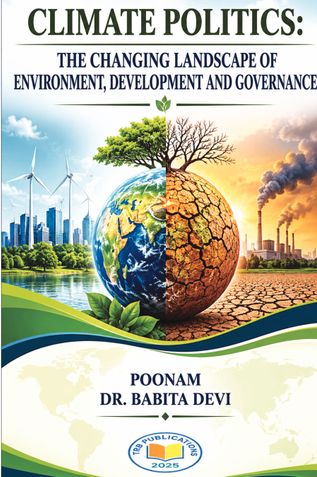
CLIMATE POLITICS: THE CHANGING LANDSCAPE OF ENVIRONMENT, DEVELOPMENT AND GOVERNANCE
Poonam, Dr. Babita Devi
This book ships within India only.
Description
Climate change has emerged as one of the most pressing and complex challenges of the twenty-first century, extending far beyond environmental concerns to influence economic development, social well-being, political institutions, international relations, public policy, and global governance. Rising global temperatures, extreme weather events, biodiversity loss, changing rainfall patterns, melting glaciers, and increasing sea levels have brought unprecedented challenges to humanity. These developments have highlighted the urgent need for collective action, effective governance, international cooperation, and sustainable development strategies. Against this background, the book Climate Politics: The Changing Landscape of Environment, Development and Governance has been developed to provide a comprehensive understanding of the political, economic, social, and institutional dimensions of climate change.
The book explores the evolving relationship between climate change and political decision-making, examining how governments, international organisations, businesses, civil society institutions, and local communities respond to environmental challenges. It highlights the significance of climate politics in shaping national priorities, international agreements, development strategies, and environmental policies. Particular emphasis is placed on understanding the role of political institutions, policy frameworks, and governance mechanisms in addressing the growing environmental crisis.
The various chapters of this book discuss important themes such as climate change and global environmental concerns, climate governance, sustainable development, environmental justice, international climate negotiations, climate finance, energy transitions, climate adaptation, mitigation strategies, and the relationship between economic growth and environmental sustainability. The book also examines the responsibilities of developed and developing countries in addressing climate change, recognising the differences in their historical contributions, economic capacities, technological resources, and developmental priorities. Issues relating to climate equity, common but differentiated responsibilities, technology transfer, international cooperation, and financial assistance are discussed to provide a broader perspective on the challenges of achieving inclusive and equitable climate action.
About the Authors
Book Details
ISBN: 9788118152521
Publisher: TRB PUBLICATIONS (An Imprint of TRB Business Solutions)
Number of Pages: 245
Dimensions: 6"x9"
Interior Pages: B&W
Binding:
Paperback (Perfect Binding)
Availability:
In Stock (Print on Demand)
Ratings & Reviews
CLIMATE POLITICS: THE CHANGING LANDSCAPE OF ENVIRONMENT, DEVELOPMENT AND GOVERNANCE
Review This Book
Write your thoughts about this book.

Currently there are no reviews available for this book.
Be the first one to write a review for the book CLIMATE POLITICS: THE CHANGING LANDSCAPE OF ENVIRONMENT, DEVELOPMENT AND GOVERNANCE.
Other Books in Politics & Society

VIKAS RUPACHAND THAKARE

Colin Todhunter

காளிராஜ்

Asraf Ali, Asraf Ali